Sunday, March 8, 2026

How Engineers Capture Existing Conditions Before Plant Upgrades

How Engineers Capture Existing Conditions Before Plant Upgrades

Mining and heavy industrial plants rarely stay static. Over time, equipment is upgraded, pipework is rerouted, structures are modified, and new systems are integrated into existing infrastructure.

Before engineers design any upgrade, one critical step must happen first:

accurately capturing the existing conditions of the plant.

In many mining operations, original drawings are outdated or incomplete. Over decades of maintenance and modifications, the actual layout of pipework, conveyors, steel structures, and equipment may differ significantly from what is recorded on historical drawings.

This is where engineering-grade 3D laser scanning has become an essential tool for engineers and CAD designers working on plant upgrades.


Engineer performing 3D laser scanning inside a mining processing plant to capture existing conditions before plant upgrades.


You can learn more about engineering scanning workflows here:
https://www.hamiltonbydesign.com.au/home/engineering-grade-3d-laser-scanning-mining-industrial/


Why Existing Conditions Matter for Plant Design

When engineers are planning plant upgrades, the design must fit into an environment that already exists.

This includes:

• pipework routing
• structural steel
• platforms and walkways
• conveyors and transfer systems
• tanks and processing equipment

If these elements are not accurately documented, designers may encounter problems later during fabrication or installation. Common issues include:

• pipe clashes
• structural conflicts
• insufficient installation clearances
• incorrect equipment placement

Capturing the plant in high-resolution spatial detail helps engineers design modifications that integrate smoothly with the existing facility.


Using 3D Laser Scanning to Capture Industrial Plants

Modern plant capture uses LiDAR-based laser scanners that collect millions of spatial measurements from multiple positions around the plant.

The result is a point cloud dataset representing the physical environment with extremely high accuracy.

For engineering teams working in SolidWorks or other CAD platforms, this point cloud becomes the foundation for modelling existing plant infrastructure.

Typical workflow:

1 – Site Scanning

Laser scanners are positioned around the plant to capture equipment, pipework, structures, and surrounding infrastructure.

2 – Point Cloud Registration

Multiple scans are aligned into a unified dataset representing the complete scanned area.

3 – Engineering Modelling

Designers import the point cloud into CAD environments such as SolidWorks to build accurate models of:

• pipework systems
• structural steel
• equipment geometry
• platforms and access structures

4 – Design Integration

New equipment or plant modifications can then be designed directly within the real spatial constraints of the facility.

This dramatically reduces risk during installation.


Supporting Mining Shutdown Projects

Many mining plant upgrades are completed during planned shutdown periods, where installation windows may only last a few days.

Accurate scanning allows engineering teams to:

• pre-design tie-ins and modifications
• fabricate equipment in advance
• verify clearances before installation
• reduce uncertainty during shutdown execution

This preparation improves the chances that installations will fit correctly the first time.

You can read more about this workflow here:

https://www.hamiltonbydesign.com.au/3d-laser-scanning-mining-shutdowns/


Engineering-Grade Scanning for Plant Upgrades

While laser scanning is sometimes used purely for surveying or documentation, engineering-grade scanning focuses on design accuracy and engineering integration.

This means scan data must be processed and delivered in a way that engineers can directly use in design workflows.

Examples include:

• CAD modelling from point clouds
• clash detection
• structural modification design
• pipe routing verification
• equipment installation planning

More detail about scanning used for plant upgrades can be found here:

https://www.hamiltonbydesign.com.au/engineering-grade-3d-laser-scanning-mining-plant-upgrades/


Laser Scanning Across Australia

Laser scanning is now widely used across Australian mining operations including:

• processing plants
• concentrators
• smelters
• bulk material handling systems
• conveyors and transfer stations

Engineering teams increasingly rely on scanning data to support accurate design, retrofit engineering, and infrastructure upgrades.

More information about scanning services across Australia can be found here:

https://www.hamiltonbydesign.com.au/home/engineering-services/3d-laser-scanning/3d-laser-scanning-across-australia/


The Future of Plant Engineering Design

As mining infrastructure becomes more complex, the ability to capture accurate existing conditions is becoming standard practice in engineering design.

Point cloud scanning enables engineers to move beyond outdated drawings and instead design within a precise digital representation of the real plant environment.


Hamilton By Design name displayed in silver 3D lettering on a tilted blue plate


For CAD engineers, designers, and plant engineers working on upgrades, laser scanning provides the foundation for safer, faster, and more accurate engineering outcomes.

Monday, March 2, 2026

Building Momentum on Mining Infrastructure Projects with 3D Scanning & SolidWorks Design


Building Momentum on Mining Infrastructure Projects with 3D Scanning & SolidWorks Design

Mining infrastructure projects don’t fail because of ambition.
They stall because of uncertainty.

  • Unclear existing conditions.
  • Outdated drawings.
  • Field changes not captured.
  • Fabrication built to the wrong revision.
  • Engineering decisions made on incomplete data.

If you want to build real momentum on a mining project — whether it’s a chute replacement, conveyor upgrade, pump skid, structural modification, or brownfield plant expansion — the first step isn’t modelling.

It’s truth.

At Hamilton By Design, we help mining operations build momentum from day one using engineering-grade 3D scanning and SolidWorks-based mechanical design workflows.

Below is how that momentum is created — and how it connects across our broader engineering services.


Step 1: Capture Reality – Engineering-Grade 3D Laser Scanning

Before SolidWorks modelling begins, we establish the true geometry of your site.

Using LiDAR and metrology-grade handheld scanning, we capture high-resolution point cloud data of:

  • Chutes and transfer stations

  • Conveyor structures

  • Pump skids

  • Steel platforms and accessways

  • Processing plant tie-ins

  • Underground or confined infrastructure

This ensures design decisions are based on what actually exists, not what the drawings say exists.


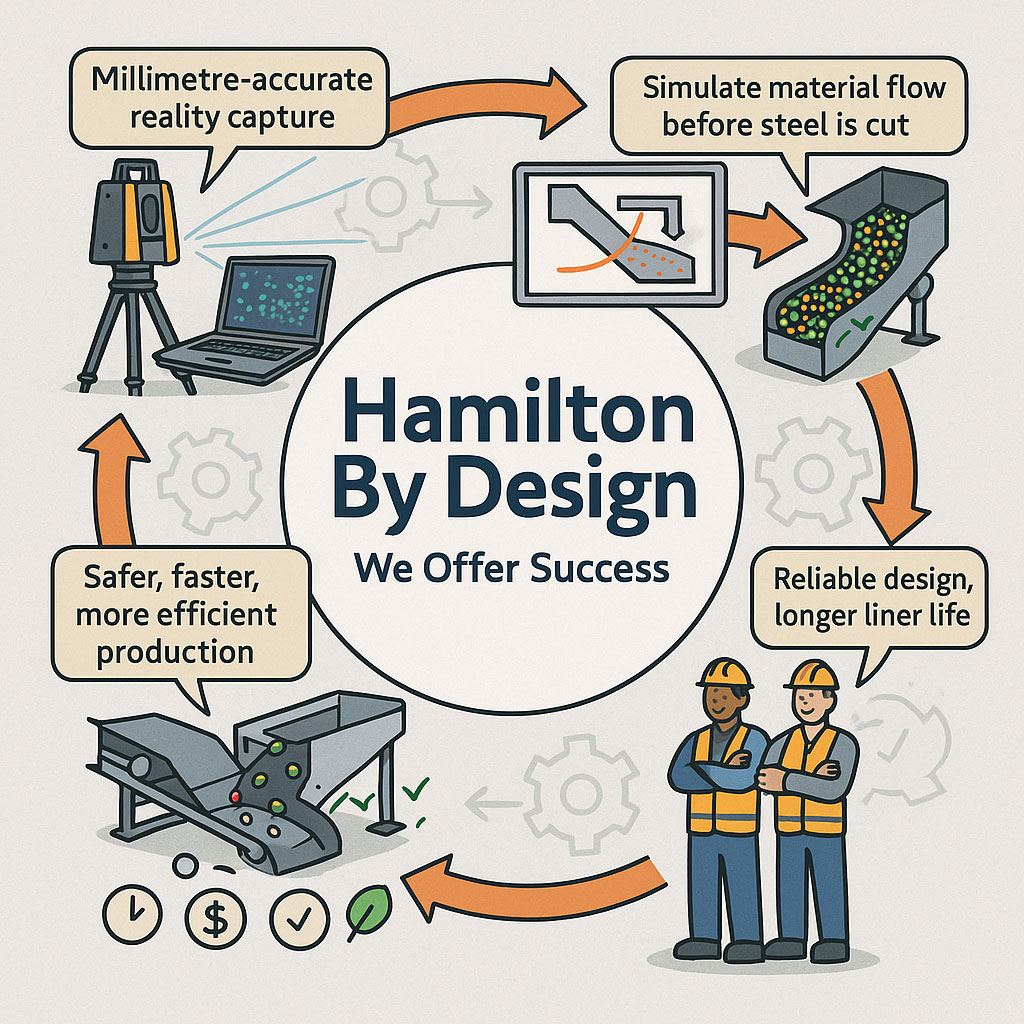
Infographic showing mining infrastructure workflow from uncertainty to installed asset using 3D scanning and SolidWorks design.


Learn more about our scanning capability:
👉 https://www.hamiltonbydesign.com.au/home/engineering-services/3d-laser-scanning/

For national capability and technical overview:
👉 https://www.hamiltonbydesign.com.au/engineering-grade-3d-laser-scanning-australia/

For digital QA workflows and validation:
👉 https://www.hamiltonbydesign.com.au/home/3d-lidar-scanning-digital-quality-assurance/


Step 2: Convert Data into Engineering Geometry

Point clouds are data.
Engineering requires geometry.

We convert scan data into structured, parametric SolidWorks models that allow:

  • Clash detection

  • Retrofit validation

  • Structural modification planning

  • Maintenance access assessment

  • Envelope clearance checks

  • Pre-fabrication certainty

This is where momentum builds.

Instead of “we think it will fit,”
you move to “we know it fits.”

Explore our mechanical design services:
👉 https://www.hamiltonbydesign.com.au/home/mechanical-engineering-consulting/mechanical-design/

Full mechanical engineering consulting capability:
👉 https://www.hamiltonbydesign.com.au/home/mechanical-engineering-consulting/


Step 3: Design for Mining Reality – Not Just CAD

Mining infrastructure is different.

Broken Hill, Mount Isa, Cobar, regional NSW — these are harsh operating environments with:

  • Abrasive ore streams

  • Constrained access

  • High maintenance loads

  • Legacy steelwork

  • Structural fatigue

  • Operational downtime pressure

Our mechanical design work in mining includes:

  • Chute and transfer redesign

  • Wear liner systems

  • Conveyor structure modifications

  • Pump skid integration

  • Structural steel certification

  • Crane runway inspections

  • Plant tie-in modelling

For regionally focused mining mechanical design:
👉 https://www.hamiltonbydesign.com.au/mechanical-design-consultants-broken-hill/

For mining-specific engineering services:
👉 https://www.hamiltonbydesign.com.au/home/engineering-services/mining-engineering-services-australia/engineering-led-lidar-mechanical-design-broken-hill/


Step 4: Build Maintenance into the Design

Momentum isn’t just about installation — it’s about lifecycle performance.

Too many mining projects deliver a new asset that becomes a maintenance headache.

At Hamilton By Design, we incorporate:

  • Safe liner change access

  • Scraper and wear component replacement zones

  • Guarding removal allowances

  • Tool clearance envelopes

  • Lifting lug positioning

  • Isolation planning

We design so your maintenance team can actually work on the asset.

If you’re upgrading chutes specifically:
👉 https://www.hamiltonbydesign.com.au/designing-chutes-for-easy-maintenance-the-hamilton-by-design-approach/


Step 5: Governance – Protecting Momentum

Nothing destroys momentum like:

  • Fabrication to the wrong revision

  • Uncontrolled drawing updates

  • Unclear document ownership

  • Poor digital traceability

We don’t just design.

We implement engineering governance.

Through structured CAD management and revision control systems, we ensure:

  • Every issued drawing is traceable

  • Revision history is controlled

  • Clients have 24/7 access to their documentation

  • Field changes are captured and managed

  • ISO-aligned document control can be established

Learn more about our engineering governance approach:
👉 https://www.hamiltonbydesign.com.au/engineering-governance-24-7-drawing-access-fea/


Step 6: Integrating Scanning with SolidWorks FEA

Momentum means reducing risk early.

When we combine:

  • 3D scanning

  • Parametric modelling

  • Finite Element Analysis

We can validate:

  • Structural load paths

  • Wear plate stress

  • Crane runway modifications

  • Pump skid dynamic loads

  • Support frame adequacy

This allows engineering decisions to be made confidently before steel is cut.

You’re not reacting to site issues.
You’re preventing them.


Brownfield Mining Projects: Where Momentum Matters Most

Greenfield projects have clean drawings.

Brownfield mining projects have surprises.

3D scanning + SolidWorks modelling allows:

  • Accurate tie-ins to legacy structures

  • Retrofit without rework

  • Pre-fabrication off-site with confidence

  • Reduced shutdown duration

  • Fewer RFIs during installation

For operations across Australia needing scanning support:
👉 https://www.hamiltonbydesign.com.au/home/engineering-services/3d-laser-scanning/

For Melbourne-based engineering support:
👉 https://www.hamiltonbydesign.com.au/3d-scanning-melbourne-cbd/3d-engineering-in-melbourne/3d-scanning-services-in-melbourne/


What Building Momentum Actually Looks Like

When momentum is working, you see:

  • Faster approvals

  • Clearer scope definition

  • Fewer variations

  • Confident procurement

  • Reduced shutdown windows

  • Safer installation

  • Maintenance-ready assets

It starts with clarity.
It builds with engineering structure.
It accelerates with correct data.


Why Mining Clients Choose Hamilton By Design

We combine:

  • Site experience in heavy industry

  • Engineering-grade scanning

  • SolidWorks mechanical design

  • Mining infrastructure familiarity

  • Governance discipline

  • Regional mining knowledge

We don’t just produce drawings.

We help mining infrastructure projects move from:

Uncertain → Verified
Reactive → Planned
Concept → Installed
Installed → Maintainable

And that is how momentum is built.


Ready to Build Momentum on Your Mining Project?

If your project is stalled due to:

  • Unclear geometry

  • Legacy plant constraints

  • Retrofit risk

  • Documentation gaps

  • Design uncertainty

Start with scanning.

Start with clarity.

Start with structured engineering.


Hamilton By Design name displayed in silver 3D lettering on a tilted blue plate


Explore Hamilton By Design:
👉 https://www.hamiltonbydesign.com.au/

Or contact us to discuss your mining infrastructure project and how 3D scanning and SolidWorks design can accelerate delivery.

Friday, January 30, 2026

How 3D Scanning Is Transforming Mining Infrastructure Design in SolidWorks

 Mining infrastructure is rarely simple. Conveyor systems, chutes, hoppers, transfer stations, platforms, and structural steel are often installed over decades — modified repeatedly and rarely documented accurately. For engineers working in SolidWorks, poor as-built information has long been a major source of risk.

This is where engineering-led 3D laser scanning is reshaping how mining infrastructure is designed, verified, and upgraded.

At Hamilton By Design, 3D scanning is used as the foundation for SolidWorks-based mechanical and structural design, ensuring models reflect real site conditions — not assumptions.


Accurate As-Built Data for Mining Environments

Mining sites present unique challenges:

  • tight shutdown windows

  • live plant constraints

  • legacy infrastructure with missing drawings

  • high consequence of clashes or misalignment

Hamilton By Design uses high-accuracy 3D laser scanning to capture true as-built geometry, providing engineers with reliable data before design begins.

👉 Learn more about engineering-led 3D scanning services:
https://www.hamiltonbydesign.com.au/home/engineering-services/3d-scanning-sydney/


From Point Cloud to SolidWorks Design

Once site data is captured, point clouds are processed and interpreted by engineers — not just converted into geometry. This allows SolidWorks models to be built with:

  • correct interfaces

  • realistic tolerances

  • verified equipment locations

  • confidence in fit-up and constructability

This workflow is especially valuable for mining infrastructure upgrades and brownfield modifications, where accuracy directly affects fabrication and installation success.

👉 Explore Hamilton By Design’s broader engineering workflow:
https://www.hamiltonbydesign.com.au/home/engineering-services/


Supporting Conveyor Systems, Chutes & Transfer Stations

Conveyors, chutes, and transfer stations are central to mining operations — and also among the most failure-prone assets when poorly designed or modified.

By combining 3D scanning with SolidWorks modelling, Hamilton By Design helps engineers:

  • redesign transfer points

  • optimise chute geometry

  • verify clearances and maintenance access

  • reduce wear, spillage, and downtime

👉 See bulk material handling and conveyor engineering capability:
https://www.hamiltonbydesign.com.au/bulk-material-handling-mining-rom-conveyors/

👉 Learn more about chute and transfer design in mining:
https://www.hamiltonbydesign.com.au/chute-design-for-mining/


SolidWorks Design for Fabrication & Installation

Mining infrastructure designs often progress straight from SolidWorks into fabrication. If site data is wrong, steel and mechanical assemblies won’t fit — leading to rework and delays.

Hamilton By Design’s approach ensures SolidWorks models are:

  • built from verified as-built conditions

  • coordinated across mechanical and structural elements

  • suitable for fabrication detailing and installation

👉 Learn about mechanical engineering and design support:
https://www.hamiltonbydesign.com.au/mechanical-engineering/


Engineering Support Across Mining Regions

Mining projects rarely sit in metropolitan centres. Hamilton By Design supports mining infrastructure projects across Australia, delivering scanning, SolidWorks design, and engineering support where accuracy matters most.

👉 Explore engineering support for mining and industrial projects nationwide:
https://www.hamiltonbydesign.com.au/home/engineering-across-australia/


Final Thoughts

For mining infrastructure, 3D scanning is no longer a “nice to have” — it’s a risk-reduction tool. When combined with SolidWorks and led by experienced engineers, scanning enables safer upgrades, faster fabrication, and fewer surprises on site.

By grounding SolidWorks design in real-world geometry, Hamilton By Design helps mining operators, engineers, and fabricators deliver infrastructure that fits, functions, and performs as intended.


Tuesday, December 22, 2020

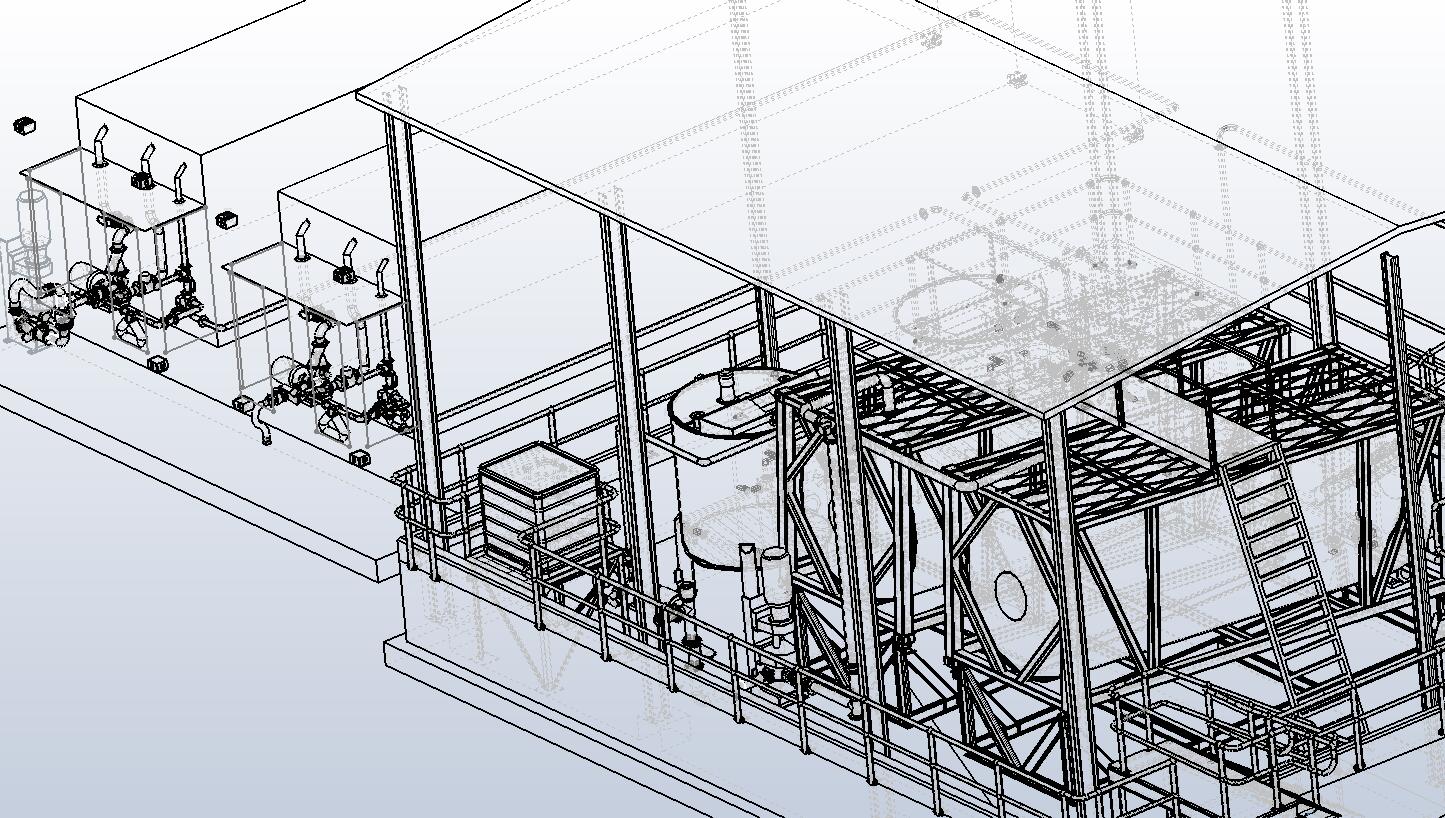
Structural Detailing: Structural Design

Structural Detailing: Structural Design:  Over the past two months Hamilton By Design have been test driving Buildworks 2012 a Solidworks add in, after extensive testing the team at...

Wednesday, July 6, 2016

Drafting For Mining Industry

Drafting For Mining Industry

Mechanical Drafting


Hamilton By Design offer 1st Class Quality

 when it comes to Structural and Mechanical Drafting

 for the mining Industry

Mechanical Drafting


Monday, June 15, 2015

Structural Mechanical Drafting for Mining Industry


Structural Mechanical Drafting

The team at Hamilton By Design has extensive experience in terms of design and detailing of Industrial Process and Mining industries. Over the past 20+ years we have been engage to design and develop and or upgrade projects and process for Mining on both fixed plant and mobile plant, Steel making process, Explosive manufacturing.

Our 3D parametric modelling capabilities are second to none combined with our extensive manufacturing know how in terms of both fabrication and machining, thus ensuring our design go together first time every time.

Structural Mechanical Mining Drafting


All of our projects are drawn using the latest 3D modelling software, which is ideal for complex structures and designs or detailed drawing production. Using the latest software also enables custom tailoring of any required reporting, cutting part lists, assembly part lists, cutting profiles or materials billing, as required by the project.
 
Hamilton By Design offer complete drafting service in terms of both Structural Drafting and Mechanical Drafting.

Drafting for Mining Industry


Some of past Projects have included:
  • Surface Handling Systems
  • Stacking and Reclaim Systems
  • Transfer stations
  • Media Drums
  • Thickener Tanks
  • Conveyors
  • Pulleys
  • Head Chutes
  • Hoppers
  • Hood And Spoons
  • Platforms
  • Stairways and ladders
  • Elevated platforms
  • Pump Skids
  • Shipping container processing Plants
  • Fluid Delivery systems
  • Vessels and furnace
  • Crabs
  • Safety Equipment

Structural Drafting


For more information contact www.hamiltonbydesign.com


Mining Drafting Services


Tuesday, May 27, 2014

Design & Drafting Service For the Mining Industry

Hamilton By Design offer a complete Design & Drafting service, we can take your ideas from concept to completion.


We offer complete detailing services for mechanical components used in the materials handling & mining industries.


Many of our Past Projects associated with the mining industry have included:
  • Special Purpose Mechanical
  • Bulk Material Handling Systems
  • Pipework and Fluid Flow systems
  • Trolleys
  • Shuttles
  • Pressure Vessels
  • Bearings
  • Conveyors
  • Chutes
  • Take-up Boxes
  • Ploughs
  • Shedder Plates
  • Hoppers
  • Screens
  • Crushers
  • Hoppers
  • Launders
  • Bins
  • Tanks
  • Stackers
  • Reclaimers